Sunday, June 29, 2014

To the North - Other Side of Greece (Part 1)

To most, the images of Greece that jump to mind are of islands, beaches, the aquamarine Med and, one would hope, ancient temples. Following recent events, there may also be a splash of rioters and torched EU flags. As I have now discovered first hand, Greece has another less well known but equally spectacular side. To the mountains and the North!
Out of Attica

In early spring last year we teamed up with the Greek family (having married a Greek, I am fortunate enough to now be part of a big Greek family) and jumped into a couple of cars with 420 kilometre of roads ahead of us to the province of Epirus and Greece’s north-westerly borders.

To reach Epirus from Athens there are two very different routes. One on a south-westerly heading, the other north-easterly. When combined they do their best to circumnavigate the almost impassable Pindus mountains which lie at the heart of mainland Greece. On the way out we chose the south-westerly path.

Once out of Athens’ ugly sprawl we soon crossed the Isthmus of Corinth, passing high above and over the Corinth canal. The canal is a marvel of 19th century engineering, cutting a deep, narrow trench between sheer cliffs, thereby artificially separating the Peloponnese from the continent.
Our road then took us across the north coast of the Peloponnese for a long stretch almost all the way to Patra, Greece’s third city. This is a stunning bit of road. It hangs to the thin stretch of coast between the mountains of the Peloponnese to the south and the Gulf of Corinth to the north, whose calm turquoise waters soon give way to the Pindus Mountains as they rise up from the depths, guarding the mainland.

Unfortunately, the simply atrocious and dangerous state of the road makes it difficult to take in much of this vista. A project to fix this “highway” was stopped mid flow when funds ran short, leaving a swerving, pot holed, cone lead death trap. As the Greeks would say “Krisi, Krisi” (“Crisis, Crisis”). Needless to say the suicidal tendencies of the Greek driving public do not help matters.
Ever a country of dichotomy, we eventually turned off this third world track onto one of the most remarkable bridges I’ve seen. Crossing back over to the mainland, the Rio-Andirrion suspension bridge, re-joins the Peloponnese to the mainland. The huge structure is designed to counter the joint problems of a soft shingle-sand base and the regular earthquakes which shake the region (not a great combo for stability).
The views from the span are fantastic. I was behind the wheel, but where possible flicked my eyes to the right. Just out there, nearly within reach, was the small patch of sea which played host to the Battle of Lepanto. A defining moment in the history of Europe, where a grand coalition of Catholic ships defeated the fleet of the Ottoman Turks and in doing so played a major part in halting the conquering of further European lands by that mighty empire from the East. To think that earlier that day on other side of the Isthmus of Corinth we had passed Salamis, where the Athenian fleet came out on top in a no less significant sea battle against the Persians. If the Europeans had lost either of these battles, the concept of East and West would look significantly different today. I can’t help it, but feeling the presence of such history thrills me. I take no fascination in the blood shed (in fact, it appals me), but the significance draws me in. One of the reasons I love Greece.

Not far from the bridge, via a scary emergency stop on the highway so not to violate a well hidden red light, we found ourselves in the town of Messolongi and took a pit stop to explore. The town has its fair share of the usual uninspiring Greek modern urban architecture, alongside a splattering of interesting sites. 
The city walls and moat provide an indication of the strategic importance of the place. An evocative cemetery pays tribute to those who died for the cause in the war of independence against the Ottomans. Grand grave memorials remember the sacrifice of many including, interestingly, Lord Byron. In a spat of romance he joined the Greek cause and succumbed to malaria in this small outpost of Europe.
That unfortunate fatality provides a convenient link to what I found most interesting about Messolongi, its remarkable setting. Within 5 minutes’ drive from the town centre, we could have been in Louisiana. A large shallow lagoon and humid micro climate have produced an ideal setting for the breeding of gazillions of mosquitos, Byron’s fatal foe, and water birds.

Through this lagoon cuts an extraordinarily narrow strip of land which sits a fraction above the water level and barely has room for the road that runs along it. Driving along it was a weird sensation. Looking out the side window, the water was so close it felt as if we were driving on top of the water.
At uneven intervals huts on stilts hover above the water with rickety mini bridges joining to the road. Fisherman cast wide nets from narrow boats and areas of lagoon are partitioned off for fish farms. The place is littered with sea birds. Of the hundreds we saw bobbing on the water and circling in the sky, a couple just so happened to be of the pelican variety. Fantastic. In short, it is nothing like anywhere I have been in Greece.
Leaving all too soon, we were back in the car and heading north to our home for the next few days, Ioannina. As we chewed up the kilometres the hills swiftly rose up around us, before becoming mountains. We were cutting across the edge of the Pindus range. At points the drive was very beautiful, cutting through narrow valleys. Eventually the land opened up into a large, flat plain shielded on all sides by more mountains. In the middle of this plain sat a sizeable lake and around this lake clung Ioannina, the historic, cultural and ruling epicentre of the region. We had a lot to explore and nearly a week to do it.

Saturday, March 01, 2014

Copenhagen - Tivoli vs Christiania


Adopting a sample approach, the following are four short happenings from 24 hours in the Danish capital.

ONE…

Grabbing some takeaway fuel for the night ahead, I started a conversation with an incredibly pissed off and sultry looking serving lady in a take out. After initially doing her best to ignore us, she about turned, became friendly and went on a tirade against Denmark. She was from Lithuania, had come over for work a couple of years back and clearly resented her hosts. She described them as condescending and racist towards Eastern European migrants. This was interesting given my only positive experiences of the Danes, but no doubt illustrative. The lady had fire in her eyes.

TWO…

After a few more drinks we sauntered into the peculiar anomaly that is Fristaden Christiania (Freetown Christiana). Amongst the Copenhagen canals, lies an island which was at the core of the European flower power movement. A mini San Francisco ’69, in the early seventies this place was taken over by freedom toting, spliff toking hippies. They even declared independence as a sovereign state, barricading the bridges from the Danish state. A lot of police raids and public debate later, Christiania and its ageing hippies remain. I had only vaguely heard of the place before, but being recommended as an interesting sight by a local lady in the hostel bar we thought we’d give it a go. 

In the day the place is apparently inviting, complete with all types of clever ecologically minded housing designs (it has a permanent population of over 1,000) and invitations to tea. At night it had a vaguely intimidating atmosphere. Walking through a branded gate and down “pusher” street the place felt distinctly dodgy. The overwhelming feeling is one of shadows. Dark except for the odd patch enlightened by some form or other of neon green strobe light (tackily enough often in the shape of a hash leaf), we shifted down the path past derelict looking buildings and eyes peering out of the darkness.

We eventually reached the “centre” of Christiania dominated by a bar and surrounding weed stalls. A bit like Amsterdam, but far less welcoming. A good portion of the locals clearly did not want foreigners around. Ignoring such sentiment we went to the bar and grabbed a round of local beers (yup, Christiania has its own brewery producing really quite delectable beers).

The place was packed with quite probably the oddest assortment of people I have shared a drinkwith. On the one hand you had the core hippies from the original movement. With long grey hair, fisherman’s pants and brightly covered clothing, their exuberance seemed to shed off their age (remember the flower power movement is 45 years old). Alongside them were a good number of West Africans, students, a small  sprinkling of tourists from all over and random uncharacterised elements. 

The great thing was that everyone was mixed up and together in what became an increasingly exuberant atmosphere of WTF let’s party. Whether reggae or trance, 60 year old hippies were twirling around with young Africans, drinks were shared and a small Nepalese (I guessed) man was strutting his lonesome stuff as if this was the best thing that had ever happened to him… Leaving was like awaking from a dream, reconciling back to normality.

THREE...

Fuelled with a significant brunch, we gingerly wandered through the charming streets and sights of old Copenhagen. We eventually found ourselves passing the palace of the Danish royal family. Being a long time Londoner I have oft cringed at the tourists posing next to the Horse Guards near Buckingham Palace. We soon discovered that the Danish royals are guarded by very similar looking guards complete with bear skin hats. With the shoe on the other foot, we jumped straight in for the quintessential tacky photo. Now I get it.

FOUR...

With Uwe back on the bike heading home to Rostock (mental guy), Dave and I headed to the renowned Tivoli gardens, the second oldest theme park in the world. Situated at the heart of the city in both a geographical and emotional sense, we thought it would be rude not to. What we found was strangely alluring. There are many worse ways to spend a lazy Sunday than kicking back on a Victorian deck chair under the sun, in the middle of a pristine lawn and before a gilded stage trooped by a brass bad. It felt like the Danish equivalent of Lords. Very civilised indeed.

Tuesday, February 18, 2014

The Route IV: Danish Breakdown


Kicking back on the top deck, legs on the outer rail, Carlsberg in hand, pastry in mouth, we spotted Denmark. Our ferry was powering straight ahead to a thin green line in the distance. From above bright sunshine, to both sides the Baltic stretching out, pierced in hundreds of places by wind turbines reaching up to the sky.

THE ISLE OF LOLLAND

Before we knew it we were in Scandinavia. We saddled up and rolled off the Ferry onto the Danish island of Lolland. Lying to the East of the main Danish peninsular which juts out from mainland Europe and to the South of Sjaelland (or Zealand in English), the island which houses Copenhagen and just under half the population of Denmark, Lolland is in the arse end of nowhere by Danish standards. It reminded me of Norfolk.

A flat, sparsely populated place, covered in (most likely) subsidised farmland. It was the middle of the day and we planned to bomb across it before dark, staying somewhere at the Southern end of Zealand. Initially it all went rather well.
From the second we exited the small port (having taken the obligatory tacky pics by the Danish flag) the cycle lanes started and did not end. Carefully planned, smooth paths by the side of the road. Many European countries incorporate cycle lanes into road plans near to cities or towns, but the Danish include them even where there are hardly any cars or cycles to bother each other. Skipping between these paths and the road we passed corn fields and the occasional hamlet. These were strange places, seemingly empty of life – we did not see one person in the first couple we pedalled through – yet up kept to a pristine standard. The architecture had markedly changed from Germany. Here we found small, sturdy gabled houses and odd little red brick churches crescented with jig-jag brick work.
After an hour or so we made it to the small market town of Maribo and went off in search of some carbohydrate. Along with loads of snacks at a local supermarket, we discovered a pleasant market square and idyllic cobbled streets leading down to large church in a similar style to the smaller ones just described, resoundingly protestant in its simplicity. Just out front was a reed fringed lake a couple of km wide. A great spot.

Having decided to head on out, I jumped back on the saddle and pushed down hard to get some purchase on the gravelly path which surrounded the lake. CRACK. I tried again. MANGLE. I tumbled off the bike. Things had taken a turn for the worse…

A LESSON IN BICYCLE MECHANICS

At first sight I could not work out what had gone wrong, other than a lot. Uwe, who is far more clued up on bikes than Dave or me, quickly assessed the situation and announced my [long German word…] had broken. Funnily enough that did not mean anything to me. He pointed at this small piece of plastic that joins (or is supposed to join) the rear derailleur (the rear thing with all the cogs) to the bike. Only now searching on google have I discovered the English name for this part - the "rear mech hanger".
I asked how big a problem it was and received the not so reassuring response of “very”. Without a new one I could not go anywhere. Copenhagen suddenly seemed a long way away. I remembered the fall outside of Lübeck and put two and two together. The part had most likely partially cracked on collision and then weakened further over the next 100 km or so before finally snapping. The weight of my beer belly probably did not help.

Time was running short and we needed some luck to fix the situation. Our location seemed very fortuitous as my bike had broken in the first proper town we had passed through in half a day. I decided not to dwell on what would have happened if it had broken 20 km earlier – I suppose a lot of waiting around in fields and possibly a spot of camping! 
The next big slice of luck came in the form of a late middle-age Danish man.  Passing by on his own bike, he saw the problem, stopped and asked in impeccable English if there was anything he could do. Before we knew it he and Uwe were off back into town in search of a bike shop. That left Dave and me kicking back on a little jetty staring out across the lake in the sunshine. Not a bad deal.

Thirty minutes later the heroes returned with a van and a bike mechanic. Nice late middle-aged Danish man said his goodbyes accompanied by our sincere gratitude. The bike mechanic shook his head. There was nothing he could do on the scene and it so happened that he doubted they had the part at the shop. This annoying little part was apparently just about the only thing on a bike that is not freely exchangeable with other makes of bikes and they did not stock Specialized (my bike). Bugger. The best he could do was to scan other bikes hoping that another part would fit, but he did not hold out too much hope. As I jumped in the van Uwe explained his Plan B with a smile. Ditch the rear derailleur and single gear it the remaining 160 km to Copenhagen. Not funny.
We soon arrived at the bike shop and, as I followed the mechanic’s slow trail around one hundred odd bikes for an strange shaped piece of plastic/metal about the length of my pinkie finger, the boys got in the beers. The occasional rising of hope as the mechanic took extra time to examine a particular bike faded to the depths as he moved on. Half an hour more and no luck. There was not even an option to ship to another town. No one stocked the part on the whole damn island. I was staring down single gear time.
As the simply lovely bike shop owner gave us a drink and bananas, a bespectacled mechanic had an idea. They could take a similar’ish metal part and use a file to slowly grind it into shape. He was not convinced it would work, but was prepared to try. To cut a long story short, this genius of a bicycle man succeeded. As we sipped beers and watched, he expertly reshaped the part into the required form. Barely EUR 40 worth of Danish Kroner (bargain) and a huge amount of thanks later, we were waved off back on the road.

TO THE FJORDS

Everything was sweet. Maribo was behind us, fields ahead. Up a couple of hills and from the top of the latter we hurtled down to a view of green giving way to Baltic blue. Past tidy farm buildings and over a bridge to more fields on the narrow island of Falster. Then ahead to a part of the journey I had been looking forward to ever since I roughly planned our route from up high on google maps. There was a big piece of sea to cross.
Falster is joined to the much larger island of Zealand by only two bridges. The nice shiny new one to the East is closed to bicycles, so our only option was to pedal across the full 3.2 km of the rickety old Storstrøm Bridge. Simply brilliant. Rising high, high above the calm sea the bridge dominates the view from miles around. We bobbled along the wooden planks of the disconcertingly dishevelled side bridge (if this was not in oh-so-safe Scandinavia I would be convinced it was a death trap…), peering down to the depths far below and out to the land, sea and wind turbines in the distance. Sea birds soared all around and the late afternoon sunshine turned the rippling waves into a blanket of glitter.
With a sigh we disembarked on the far shore and headed round the headland to the small harbour village of Vordingborg to figure out what next. As it worked out, short term perfection. We discovered a small natural marina perched on the north shore of a little fjord surrounded by patches of forest. Shore side of the dozens of small sailing boats were a couple of bar-eateries and a tiny fishermen’s hut inhabited by an ancient fisherman complete with crazed look.
We sat down, ordered the local beer and some fish and admired the setting from a sea side bench. It was decision time as, being early evening, only the long days of this northerly latitude was saving us from the dark. A quick second beer gave us fortitude and we decided to cut across country for another 20 km to the town of Praesto. There was sod all on the map in between and we had no idea what we would find when we got there, but it sounded like fun.

The ensuing final part of the penultimate day of our ride was up there with the most enjoyable route parts to date. Unexpectedly finding some Danish hills, we cycled through an undulating countryside of great beauty. It somewhat reminded me of Dorset. Flushed with the buzz of the end of the day we sped along the winding, dipping, climbing traffic free roads as the setting sun blinkered in and out through the roadside foliage.

By the time we rolled into Praesto it was getting on for 10 pm and all but dark. We found a well-kept, yet seemingly deserted, market town. We pedalled onto the high street hoping to find a place to stay, but there was no one to ask. At last we approached a kebab shop frequented by 3 people. Without much hope we asked for help and, as it turned out, it was our lucky day. One of the guys knew the owner of a small B&B opposite. He rang the owner, who had a room and returned within 10 minutes with the keys.
He took us up to a simply awesome apartment (complete with oodles of proper coffee) and offered it to us at a very reasonable rate. We nearly bit his hand off, even more so when he informed us of just how lucky we had been. Being July the town was completely booked out and he would not have had a room had it not been for a rare cancellation earlier that day. Maybe next year I will think about booking ahead… but where would the fun in that be!
After a very quick scrub up we wandered through the dark to the harbour. If possible, even more idyllic then the one we had just passed through at Vordingborg, here we were fjord-side beneath the stars. Prior to this I hadn’t even realised Denmark had Fjords! We sank into some extortionately expensive beers (I knew this country had to have its downside) at a harbour side pub thinly populated with good looking middle-aged blond people, an ’80’s rock cover band (how predictable) and some disturbing cartoons in the gents…
BEACHSIDE RIDING TO THE CAPITAL

We woke up relatively early on the final day of our annual cycle (that is early for me and Dave, but a touch on the late side for Uwe). Around 90 km and a night out in Copenhagen awaited. After a ridiculously good breakfast and some interesting chats with the owner about his time working in the kitchen of the Dorchester, we were on our coffee fuelled way.
Our morning ride out was fantastic, along the Fjord and then hugging a rugged coastal path. I had loads of energy and sprinted ahead, stopping to admire the Baltic views. Heading straight for the town and port of Køge, our path transformed into a proper road and we put our heads down into full peleton, powering all the way to the outskirts. By the time we had arrived that initial energy had well and truly passed and I couldn’t wait to get my face into a pastry (or as it happened three!). We followed up this face stuffing with a cold beer in the market square. As we took in the surroundings it was noticeable how the people had become better looking as we had made northerly ground.
From Køge to the capital is only 40 km on a fast road which runs a stone’s throw from the beach. As time was on our side we veered inland in search of a final stretch of countryside. Our discovery of a pretty village or two and a windmill was countered by the onset of rain and an Uwe puncture. We were soon back on the cycle path which attached to the main road making fast headway to the capital.

At a pit-stop in between WWI era battlements and the sea, I was outvoted on the idea of a dip into the Baltic. Living in Rostock, Uwe saw no excitement In a Baltic dip and Dave was just being a wimp about the cold. Saying that Dave probably had a point as it was pretty miserable and I guess that was why I didn’t just go it alone, consoling myself that my first hand encounter with the Baltic would be only postponed to the Swedish leg of the route.
We continued North on the road, but in all truth it was rather a dull commuter artery. This prompted one final detour across and onto the sandbanks which run along the coast parallel to Copenhagen’s southern edge. This proved to be a nice bit of riding past sail boats, over narrow dykes and under high dunes. Unfortunately our journey was drawing to an end. Via an underpass, the coast was soon replaced by ugly outer city roads.

Having a population of circa 2 million (if you count the metropolitan area), I should have expected Copenhagen to be quite large, but the size surprised me. It took quite some time to reach the historic centre, passing from the industrial ugly outer part, through steadily increasing density and, frankly, attractiveness. By the time we were peddling down the high alleys of the streets approaching the Rådhuspladsen, the focal square of the city, we were in a positively bouncing mood.
Cycling through a city at the end of a cycle trip is an elevated feeling. You are in your own little bubble. For you it is the goal of a few days on the road. A sense of fulfilment at what is behind and excitement at the celebrations to come. I find I take in every detail, savouring every last turn and sight. A real juxtaposition against those every day inhabitants you pass for whom, at that same moment, the streets hold no wonder.
A final patch past the imposing Rådhus (city hall), we weaved in between the throngs of the Rådhuspladsen while Uwe did a strange Lycra bike jig to the Andean Indian pan pipe man. A few lost turns in the old back streets later, we arrived at the little square which housed our hostel and, well wouldn’t you know, a bar.

COPENHAGEN
Laying our bikes against a tree we grabbed an outside table at the bar, parked our bums and ordered celebratory beers. 365 km pedalled in 3 days. Smiles on our faces and feeling good. Before we knew it were discussing the next trip (France… Sweden… Spain…?), briefly interrupted by a sincerely peculiar over weight man seemingly sniffing our bikes for a good couple of minutes.


As the sun went down, we gave the Lycra a good slap, sunk our beers and embarked on a night of unexpected destinations…

Sunday, January 19, 2014

The Route IV: Farewell Germany - Hello Baltic

Now a firm annual adventure, part IV of the St Petersburg to Lisbon cycle trip set off from Hamburg, destination Copenhagen. Three days to set aside what remained of Germany and make inroads into Scandinavia via just under 380 km of road and track.

HAMBURG AND OUT

Dave and I had flown in from London mid-afternoon, arriving just before Uwe who had taken the train from Rostock. We had convened a night early to celebrate Dave’s birthday and were in the mood for a few drinks, though perhaps not quite the level of carnage which adorned our last night here after the Dortmund to Hamburg cycle (I am still scarred). No Reeperbahn this time! Instead we stayed around the corner in gritty, yet enticing Schanzenviertel are of St Pauli. 

To most of the world Germans are famed for being straight laced and efficient. From my own encounters and experiences I can’t deny this strong part of the national character, but think that, at least in the big cities, it is counterbalanced nicely by an edgy grungy counter-culture which the Germans do so well. Graffiti, dreads, beats, off the scale art work and anti-establishmentarianism. Put it all together in an area like St Pauli and it is undeniably cool. Needless to say we had a good night, starting out at the best fish and chips place I have ever been to, before milling about from one bar to another, sipping down the beer and caipirinha and soaking up the atmosphere. Generally getting in the mood for the trip ahead.
A little too in the mood as it happened… I woke at 6am to run to the toilet and said hello to second hand caipirinhas. We did not even drink that much! Age and overly-acidy drinks had clearly caught up with me and I spent the next couple of hours feeling distinctly sorry for myself. The sensation of fresh lycra, talcum-powder and vaseline did not help (the daily pre-cycling routine I will have you know) and as my bum nestled onto the seat of the old trusty bike, I felt terrible.
Fortunately the first part of our cycle took us less than 500m to a bakery where a session of strong coffee, juice, chocolate milkshake, croissant and unidentified baked goods set us back on the right course. Efficient as ever, it was half ten by the time we set off proper. I for one was though feeling markedly better. As we weaved our way through the streets of central Hamburg, the caffeine, adrenaline and excitement at the journey ahead merged to elate and have me positively bouncing along past canals, churches and a series of lakes dotted with small sailing craft. Then to more canals and grand residential streets, guided by my compass and a vague heading of Lübeck (well at least north-east’ish).

It was a surprisingly pretty start to our ride, especially given the industrialised ugliness that had greeted us when first entering the city from the south on our previous cycle trip into Hamburg. The city is though huge, and within 40 minutes the distractions of the centre had given way to seemingly endless bland suburbs. On and on as the hangover trickled back in and the sky greyed over. An hour or so of relative drudgery later we finally broke out into a semblance of countryside and tried to work out where we were.

Our swivelling guess at a north-easterly heading on winding suburban roads had taken us out further south than we had hoped. The disadvantage of additional distance was more than counterbalanced by stumbling across a rather exquisite 16th century castle at Ahrenburg. An uninspiring landscape was lit up by a whitewashed multi-storey block of fortification rising from a moat. I pedalled off in its vicinity, with Dave and Uwe close behind. Quite fittingly it turned out to be a castle originating from Danish aristocracy. A sign informed me that nearly all of our journey to Copenhagen was once part of greater Denmark (even though a good half of it is in modern day Germany).
Cycling on, we passed through fields and small towns through the early afternoon. Against the odds the heavens had not opened up, leaving us in good spirits which were further lifted by the inevitable pit-stop for sugar fuel and some medicinal Jaeger. We flew along and were soon on the outskirts of our first major destination, Lübeck.

Having passed the city sign, we were pelting down a hill on the outskirts when I screwed up. Lapping up the smooth cycle path with greed, I was positively zooming past other cyclists when I made the mistake of running 20 cm wider than intended and touched my front wheel on to the soft leaf strewn turf which ran beside the path. Most cyclists will know with dread the sensation of losing control. The wheels take on a mind of their own, ignoring the breaks and veering on their divergent paths. Attempts to control the skid inevitably make it worse and before you know it the bike is crashing sideways and you are left with little option but to jump. Jump I most certainly did, transferring into an early Man U era Ronaldo multi-barrel-role and, to my surprise, out onto my feet. Adrenaline pumping, my thoughts quickly shifted from survival via embarrassment at the fall to marginally compensating pride at ending back on my feet. I then snapped out of the self-reflection to tend on the elderly German gentlemen who had to skid stop as a result of my mild calamity. He was not overly impressed, but was OK and seemed to take on board my half-German apologies before peddling off in a bit of a huff.

Checking myself over I was relieved to find nothing more than the odd bruise, minor scrape and a disconcerting cracking of my left wrist every time I turned it. As this was not accompanied by pain, I chose to ignore it. We had the best part of 3 days cycle ahead of us after all. The bike was a little scratched, but not in obviously damaged condition. Gingerly jumping back on, I followed the others down the remainder of the slope and into the historic German city.

LÜBECK

Once capital of the mighty Hanseatic League which effectively ruled the Baltic in 14th century, Lübeck is a beautiful city blessed with a grand legacy from its past. Entering through the gothic Holsten Gate and over the river Trave, the towers of churches and cathedral punctuate the sky above the old town. Despite the trickle of rain, it really was a delightful place. We meandered our way past medieval streets, up through the more modern commercial centre and ended up in the main square. Time for the first wurst of the trip. Just the ticket!
As usual, setting off late meant we couldn’t linger too long on route, but we had just enough time to visit St Mary’s church with its searing twin towers and cracked bell. A chilling reminder of European self-destruction, an Allied WWII bomb damaged the cathedral and sent one of the giant bells hurtling down from one of the high towers. It crashed into the ground splintering as it gauged out the earth. Today it lies as it fell in 1942.
There was also just about enough time for a beer… An almost overly-friendly buxom middle-aged German bar lady let us wheel our soaking bikes and kit into her narrow old fashioned bar. She clearly found us amusing. I digged the 80’s big hair rock on the radio. The beer was good as always.

The rain having slightly abated we jumped back on the saddles. The day quickly running by we decided to head to the Baltic coast by the most direct route, straight up. It was mid-afternoon and we still had half the day’s distance to pedal.

THE BALTIC

Out of the city and through more greenery, we cycled for an hour or so via Bad Schwartau - I don’t recall anything of the town but the name just stuck - fields and then the sea. The Baltic conjures up images of ice-strewn channels, wind, cold and fjords. If we are to make it to St Petersburg we will circumnavigate half of the sea via Denmark (imminently), Sweden, Finland and Russia (god know when). Our first sight came at Timmendorfer Strand.
Startling. Special. Unexpected. We waddled – disembarking from a long cycle you always waddle – across the boardwalk and onto the powder white sand. This picture-perfect beach stretched into the distance on both sides. Neat German buildings fronting small grass-tufted dunes, the beach and then the blue sea.
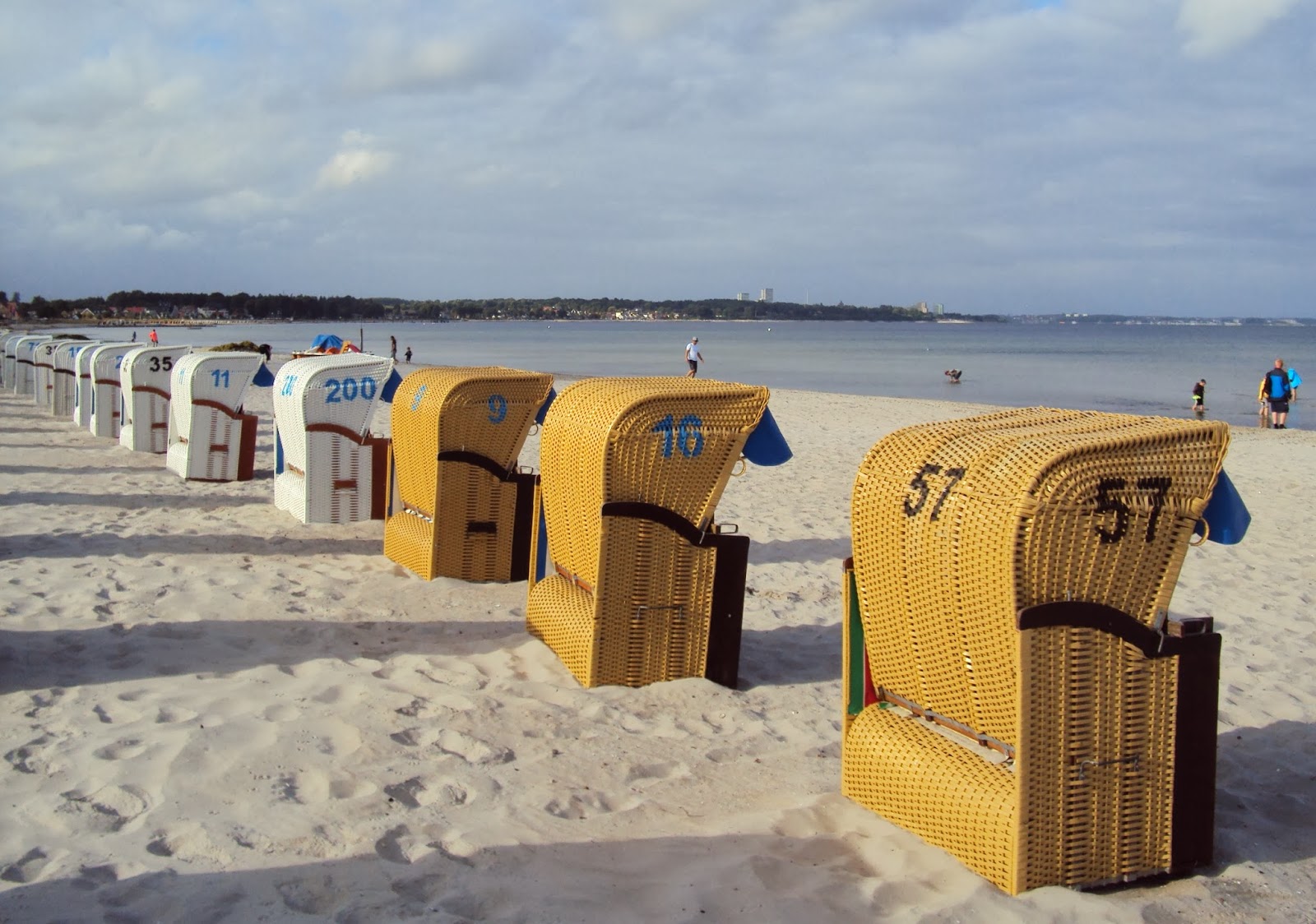
Apart from its beauty, the other stand out feature were hundreds of what looked like large hooded wicker chairs. On closer inspection, this description did not do justice to a quintessential German invention. Scattered across German beaches since 1882, Strandkorb (literally beach basket) are a product of the co-mingling of the deck chair and beach hut to produce something of pure practicality and a sort after dollop of privacy. Carefully designed to shelter from sun and wind, (the latter being a bigger problem in the Baltic), Strandkorb include comfortable cushions, easy-boy type adjustable foot-rests, airline type fold away tray tables and ample storage space. Past their heyday but carefully preserved, they are items of local pride and are largely frequented by older members of society.
The sun had burst out and we decided to push on to Neustadt our absolute minimum end point for the day. It was a lovely ride. The smooth road followed the beach-line and, via a bridge over a river, led us to the small old port. Our luck was in. As it just so happened, the river front was adorned with a brauhaus. Time for strong, cold local beer and herring in the late afternoon sun. Perfect.
With our spirits when and truly up, we all agreed we had a few more km in the legs and carried on to the north on the beach side road. Another 45 minutes and we would make it to the upmarket seaside resort of Grӧmitz and, with a bit of luck, to a bed for the night.

By the time we made it to the town we had travelled nearly 120 km, the legs were starting to feel it and the sun was sinking low. We popped into the first hotel we saw and asked for a room. No rooms. Where do you recommend? A response of no rooms in town accompanied by a bewilderment at why on earth people would ask or expect to obtain a room at such short notice in high season. It clearly was not the done thing in these parts. It is Germany after all.

We asked in another hotel. Same answer. We asked in a bar. Same answer, accompanied by confused laughter. Bugger. In a stick or twist scenario, we chose to twist. A couple of km up the coast were some campsites and, if that failed, a final flip of the coin at a smaller town 10 km to the north.
No luck at the campsites where we were greeted with friendly signs of “No reservations after 1800”. There went my dream of adding caravan to the lengthening list of accommodation on the route (boats, hostels, prisons, floors, B&Bs etc.).
We were getting desperate and the sun was setting as it dawned on us that we might be sleeping rough. Still surrounded by lovely scenery, we took a “short-cut” along a coast edge path. A thin, wobbling dirt track which went over dunes, fields and then into a wood. Something appealed to me about dodging roots in the dark in a Baltic forest. Well past 9 pm it was getting quite comic.

Finally we arrived at Kellenhusen. We asked at the first hotel. No luck and the same bewildered looks. We asked at another. No rooms, but a glimmer of hope. A friend down the road had a place that might just have a room. We rushed across town and in the pitch dark arrived at a plush yet homely small hotel. A lovely lady greeted us with the even more lovely news that they had two single rooms. One of us would get the floor, but who gave a damn. We had shelter!

It had been quite a day and I soaked up our post-clean up walk along the sea front. A huge helping of 
pizza, a beer and we were off to bed.

THE END OF GERMANY

After a calorie fuelled German breakfast, with talcum powder, vaseline and lycra in place, we were off again for our final stint in Germany.

Veering inland, we pressed ahead at good speed throughout the morning, passing pretty countryside as we went. Despite our rather freestyle approach to navigation, we made it to Hellingenharfen in good time. Our last meaningful stop in Germany, we stocked up on German baked goods (to be missed on the rest of this journey) and loitered on the twee high-street of this tourist town. Away and over the sea bridge to the isle of Fehmarn. We had left continental Europe and had one small island and a short ferry between us and Scandinavia.

Wind turbines littered the landscape to both sides as we detoured off the main roads. A small village or two later our approach to the port was heralded by the onset of ugly industrial buildings and cheap hotels. Appreciating the wonders of free movement of people within the EU we pedalled through customs and straight on to the waiting ro-ro ferry, at least in my case, singing as I went.

After a combined 7 days on the saddle across Germany via some 700 km, dozens of differing towns, villages and cities, the Rhine, the Weser and the Elber, a prison and castle, wurst and beer, we were on to the next country. We parked the bikes and went on deck to sip a beer and try to sight Denmark!