Friday, January 03, 2014

Hellenic Octopus Hunting

The weather in Greece is usually good, sometimes great. Heading out for a week at the crossover of October and November, I expected early winter weather and hoped for blue skies. To my surprise, we arrived to 26° C basking sunshine and were in for some beach time.

Spending the morning at a public Athenian beach on the Saronic gulf, a middle-aged Greek man in speedos gave me an offer I could not refuse. Want to come Octopus hunting?

While on the Greek islands, I have seen fisherman using long tridents to skewer octopus from small boats, but I have never before seen it done the more hands-on way. Here I was being invited to not only see it, but help do it. While I was traditionally squeamish of such things, I am increasingly interested in seeing how things end up on my plate.

Costa is a specialist. Whenever on the beach, he kits up, leaves his wife to the sun and sets out in search of eight-legged food. The kit I mention is nothing more than a snorkel, mask, fins, knife, hand-spear, buoy on a rope and a small bottle of unidentified liquid tucked into the back of his tight speedos. Before I have had time for second thoughts, Costa has chucked me his spare, rather tired, snorkel and mask and we were off into the shallows.

The water was much warmer than expected. The beach was hemmed in on one side by a marina and on the other by the coast itself, as it turned at a right angle before opening back up into the wider bay. We swam straight out, beyond the sheltered cove and into more open sea. I immediately saw why the buoy was a necessity. Costa’s hunting ground was in a channel frequented by speed boats (and crazy Greek speed boat drivers), and a fluorescent buoy on the surface gave him a chance of not being hit when diving under the waves.

Only having bare feet, I had to front crawl at some pace to keep up with the fin propelled Costa. At regular intervals he would duck dive, glide down to the bottom and investigate the scene for our prey. I dived down after him, looking where he looked, and trying to understand his approach. If I picked up enough, I could hope to catch my own 8-legged delicacies on Antiparos!

He explained the tell-tell signs of octopi. They like to hide under ledges or burrow down into holes, covering themselves with stones for camouflage. The octopi in these parts have a habit of flinging out small white stones from their hiding place, providing a give-away circular pattern.

Over the next hour of swimming, diving and searching, we found a number of these lairs, but each time they were empty, the previous occupant either having moved residence or been eaten. I was beginning to lose hope when Costa gestured to me excitedly. I looked over and he pointed at an outcrop of rocks roughly 4m down. “Octopodi, Octopus”. As hard as I peered I could not make it out, so he dived down and pointed his hand-spear right at it. Undoubtedly an octopus. Great! What next?

I dived down as it retracted its tentacles and all but a sliver of its body under the rock shelf. Costa took some air, finned down next to the shelf and thrust his spear into the body of the octopus. It jerked back and disappeared from view, leaving only the end of the spear poking out from the overhang and jiggling in protest. Another dive down and Costa reached in to retrieve the octopus, but to no avail, as the creature backed up further, out of reach.

Just as matters looked forlorn, Costa took out the small bottle of liquid from the back of his speedos. We dived down together and I watched him squirt a small amount of the liquid under the shelf and into the vicinity of the octopus. There was no immediate effect, but after a few seconds delay, a couple of its legs unfurled in our direction as it repulsed from Costa’s liquid and made the fatal error of moving within Costa’s grasp.

In an instant Costa had grabbed the octopus by the head and wrenched it out of its hole. All flailing, rasping, sucking limbs, the animal did all it could to right itself and sink its sharp beak into its adversary. Costa surfaced, fighting fiercely with both hands. As the octopus clenched all of its limbs around his forearm and writhed one way and then the other, Costa felt for a lip over the back of its head, pulled and inserted his hand.

To my shock and wonder, he stuck his digits right in and ripped and retrieved what looked like a significant portion of the octopus’ brains. The fight of the octopus only fortified. It expelled gushing quantities of black ink which enveloped Costa’s arm. Costa flipped between thwarting the octopus’ attempts to turn on his flesh by ripping the grip of its legs off his arm and delving back into the head cavity, pulling out more brains and internal vitals.

After a last furious effort, the fight fizzled out, Costa ceased his internal excavations and handed me the octopus. Yes, that’s right, handed me the oh-so-recently flailing animal. I took hold of the head only to quickly reject it as the legs of the brainless mollusc reached up and tangled around my arm, gaining purchase with their suckers. I regained my composure and took hold of the head again before the octopus sank down.

With a smile, Costa ushered me on to find more octopus as I struggled behind in an awkward one-armed freestyle. My other arm was doing its best to drag the octopus in just the right way so that its limbs were left trailing behind by our forward propulsion (and hence as far as possible from my arm). Intermittently I lost this little battle, one tentacle after another creeping back up my hand and sucking onto my skin before I slowed and wrenched it back into the slipstream. An enlightening, if slightly grizzly experience. Eventually, the octopus stopped moving.

After a long, drawn out search for the first octopus, our luck was in. Costa soon found another hidden in a crumpled rock formation. After close inspection he informed me it was only a juvenile and better left alone.

We moved on, in a wide arch back towards the beach and, unfortunately, to the inevitable return to normality… until… just as we passed the shallow outcrop of flat, creviced rocks that spread out from the edge of the bay… I spotted it. A large octopus squeezed down in a narrow channel carved through an otherwise flat rock. I raced in front to grab Costa’s attention, ungainly resorting to pulling his fin. To my relief, the octopus was still where I left it when Costa and I came back.

Time for a new technique. Costa explained how an octopus in the hand can make it easier to catch more. They are cannibalistic and are attracted to the smell of their kin. On Costa’s instruction I dived down and flailed the recently deceased octopus over the opening above the very much alive octopus. Its tentacles tentatively reached out, but not enough for me to grab it (to this day, I am not sure if I would have actually grabbed it).

I surfaced ready for another attempt, only to be interrupted by a call from a swimmer. I had completely lost track of time. What had been just a blink of an adventure in my head, had taken over two hours. I was needed back in reality. I gave my apologies, left Costa to take another octopus for the pot (or grill - I prefer it on the grill) and raced back to shore.

That night I dined on octopus.

Saturday, November 09, 2013

The London Triathlon 2013


I signed up for the Olympic distance London Triathlon at the end of last year. The prospect of a 1.5 km swim, 40 km cycle and 10 km run around the monuments of London excited me. Every so often I need a new challenge and I find that things of this nature give an additional focus to a year and provide a helpful incentive to get off my arse and be a bit more healthy. I had added incentive this year, hoping to raise funds for a charity dear to a very poorly friend of mine (the fantastic Royal Marsden). There was therefore no turning back.

The challenge of a triathlon is balancing the training and race effort on the three very different disciplines. I have done quite a lot of cycling, run the odd half marathon and the solitary full marathon, so I made the conscious choice to concentrate nearly all my training on the swimming. In this choice lay future pain…

I have always considered myself a reasonably strong swimmer, being the water baby that I am, but the truth is that I have never been all that good at freestyle. I am fine over a very short sprint, but I have never been able to get the breathing quite right. Triathlon obsessed friends had recommended doing a bit of coaching, but I could not quite bring myself to spend the money. So I just practised.

Weekly swims at the local pool shook the rust off and got me going, and I finally became a half competent freestyle swimmer going back and forth and back across a bay in front of my Greek house. A month of 1 km a day swims put me in better shape than I have been for years. Better still, covering so much distance just above the sea floor turned into a surprisingly fruitful Mediterranean wildlife safari. Squid, snails, flatfish, flying gunard (check them out on google - very cool), octopus and a dozen other variety of fish. The most remarkable and surprising encounter was a 5 minute swim next to a trumpet fish. These long, thin, alien looking fish are not even meant to live in the Med. It appears a few have slipped through the Suez Canal!

As for runs and cycles, let's just say I went for the minimalist training approach... and as for combining these disciplines with each other in training the very minimalist approach. 

THE ARENA


My thoughts of an idyllic race around the landmarks and prettier parts of London were dashed on arrival. Setting off from the Excel centre in the east end docklands, the route stuck resolutely to unattractive parts of the capital. The swim was to be in the sloppy green water of the dock, the cycle around a loop of an East London dual carriage way and the run around the Excel centre itself. Not exactly inspiring.
That is where my complaints of the event cease. So much effort goes into arranging the biggest participation triathlon in the world and they do a great job. There is a carnival, if a bit corporate, atmosphere at the Excel. Thousands of people milling around stalls which are selling (and occasionally giving away) everything triathlon related you could imagine and a lot more besides. I felt a real amateur with my knackered old hybrid bike, borrowed wet suit and speedos. Everywhere I looked were hardcore triathletes with top of the range break the bank road bikes and tri-suites.

The scale of the place and occasion struck home when I made it through to the change over area. Rows upon rows upon rows of change over lanes, complete with parked bikes and kit. This is a key part of the logistical nightmare of arranging a triathlon. Shepherding huge amounts of people at varying times in and out of a confined area to prep for the swim, transition from dripping wet wetsuit into cycle gear and then finally get ready for the run. This vast hall had room for a couple of thousand people at a time. I was not sure I was ready for this!

THE RACE

If you want to do “hopeless amateur” at a triathlon, I doubt there are many better ways to line up at the start line then with your wetsuit back-to-front. Having only tried on the wetsuit once before since borrowing it from a mate (thanks Ramsay), that is exactly what I did, triggering an embarrassingly ungainly torso tustle with neoprene in front of the crowds.


Now sweating and a bit perturbed, I joined in with the rest of my start group in the MC prompted high-fives and manly war grunts. Then out the door and into the disconcertingly green Thames water in the Royal Victoria Dock.
Thanks to Virgin Triathlon for this pic
I had heard many a horror story of triathletes beating the shit out of each other on the swim, all punches, pulls and half drownings. Whereas there was the odd inadvertent heavy contact with those around me (usually I imagine at my doing), overall I found the swim a pleasant experience. This is the part I had trained for and to my satisfaction it all went smoothly.  Trying to save something in the tank for legs 2 and 3 of the triathlon, I did not push myself too hard, but still finished the 1500m in the better half of the pack in just under 32 minutes.


Scrambling out the water and back towards the change-over zone, the enthusiastic crowd provided a real buzz of an atmosphere. Eventually finding my rack, I had to strip down and out of my budgie-smugglers and into my cycle gear without any stewards spotting my momentary nakedness (for some hyper-moral reason the powers that be at this triathlon have a real issue with people showing off their bits). That small feat achieved as part of an exceptionally unimpressive change-over time, I clipped into the bike and rolled out onto the road.
To my surprise and annoyance, I was climbing a hill before I knew it. One of the reasons I had chosen the London Triathlon was out of a misguided notion that London is flat and therefore I would not have to pant up and down inclines. I was wrong. The organisers had seemingly specifically chosen a route that goes up and down and up and down a series of tunnels and bridges, replicating some not inconsequential climbs. The impact of this on my performance was made clear as over and over, having past riders on the flat, they would then fly past me on the climbs on their multi-thousand pound feather light road bikes as I struggled with my chunky knackered old hybrid.


This impediment did though bring rewards. Over the three laps of the course which lead from the Excel centre up towards (but not close enough to see) Tower Bridge and back again, I inadvertently played tag on repeat with another rider. We must have passed each other a dozen times. It was a really nice touch that he pulled alongside as the cycle came to a close and said, given that we had raced together for 40 km, we should finish together.
In toe behind my fellow rider, I made it up the ramp in a pretty average 1 hour 16 minutes for the ride. Not an awesome time, but given I had not really trained for the cycle and was riding the bike equivalent of a Volks Wagen (while most people were riding Porsches), I was relatively happy.

So to a quick change of shoes and onto the run. Only 10 km to go, comprising 3 short laps of a meandering course in and around Excel. As it turned out, a big “only”.

From the second I started jogging out over the start line, I knew I was struggling. Vengeful cramps wrenched my lower thighs and I really struggled to keep lifting my legs. I suddenly realised why everyone recommends that you combine different parts of the triathlon in your training schedule. The pumping of the pedals up and down the hills had left my upper legs shot and not prepared to run. As I hobbled along in significant pain I vowed to myself that I would train properly next time...

Being the bloody minded bastard I am, there was no chance of me not finishing, but on that first lap it was all I could do to alternately drag my legs into a faltering jog before falling back to a few seconds of walking. It is at these times that the crowd and other competitors really help. The triathlon has oodles of good will and camaraderie and there is mutual encouragement from all angles that spurs you on.

By the second lap the pain was still there, but I could feel the cramps starting to recede, replaced by sheer tiredness. I pushed on into a slow non-stop jog accompanied by a grimace. It felt like a long time before I crossed the line for the start of the final lap. I had thus far not concentrated on the time, but allowed myself a quick glance at the clock over the finish line. Given the trouble I was having with the run, I had long ago given up any idea of getting a decent time and was just looking to finish the race. To my serious surprise, on calculating my race time from the clock, I realised that if I got a move on I could still make sub 3 hours. All I needed was a 19 minute last lap.


As it turned out, this was just what I needed to get my arse into gear. With further grimaces and a self promoted fire up my arse I left every bit of energy I had on the route of the final lap. Running through the finish straight with the crowds cheering was a feeling of heightened exhilaration. The last surge of adrenaline drained out the pain and tiredness, leaving this fantastic buzz of endorphins and relief.
Crossing the line in 2:57 I was pretty chuffed. I even allowed myself an indulgent arms outstretched moment before the pain took back over and, hands over hips and bent double, I sucked beautiful oxygen back into my system.

In the immediate aftermath my thoughts veered between... if I just train properly, purchase a road bike and triathlon gear I could get my time down to 2:30... and... thank god that's over!

Despite the rather uninspiring East London location and inherent pain, the London Triathlon is a great event. A lot of people getting together with passion and a sense of common purpose to do something a bit different. An addictive buzz, but whereas I definitely plan to do a triathlon again, I don't think I was ever in danger of falling for the all too common pitfall amongst triathletes of obsessing over the sport to the point where other interests dwindle away and you have little else to talk about (I always have something to talk about!). If a friend of yours has ever done an iron man you will most likely know what I mean...


So to next year and a new challenge yet unknown. A final thanks to all those who sponsored me and raised money for the phenomenal Royal Marsden (http://www.justgiving.com/jimbo82-tri).

Wednesday, October 23, 2013

Al Andalus - Granada

Central Andalusia is a relatively barren, hilly country. Once Cordoba fell to the Catholics, this was the frontier zone between Christianity and the last stronghold of Islam in Western Europe, Granada. As a product of those times, towns and villages were largely built on hill tops and fortified against the opposing side. This has left a beautiful spectacle for those driving through, as the roads skirt below white-washed towns with the obligatory crumbling fort.
I have wanted to visit Granada for a very long time and my first glimpse galvanised my growing excitement. Coming to the end of a high pass, the hills split and dropped, exposing a wide valley stretching to the snow-capped Sierra Nevada. Just visible, nestled in the rising roots of the mountain range, Granada sat invitingly.
Being a bit of a romantic, I had booked to stay in a guesthouse high above the city centre at the meeting point of the historic Albaicín district and Sacromonte, home to centuries old picturesque gypsy cave settlements. This area has no parking and I will spare you the details of shifting two kids under 20 months old with all their cots and baby paraphernalia from an out of town multi storey car park, across the whole city, through the narrow streets of the old town, part the way up a mountain and up to a villa that can only be reached via a crumbling winding stair. Impractical, but worth it, the place was amazing.
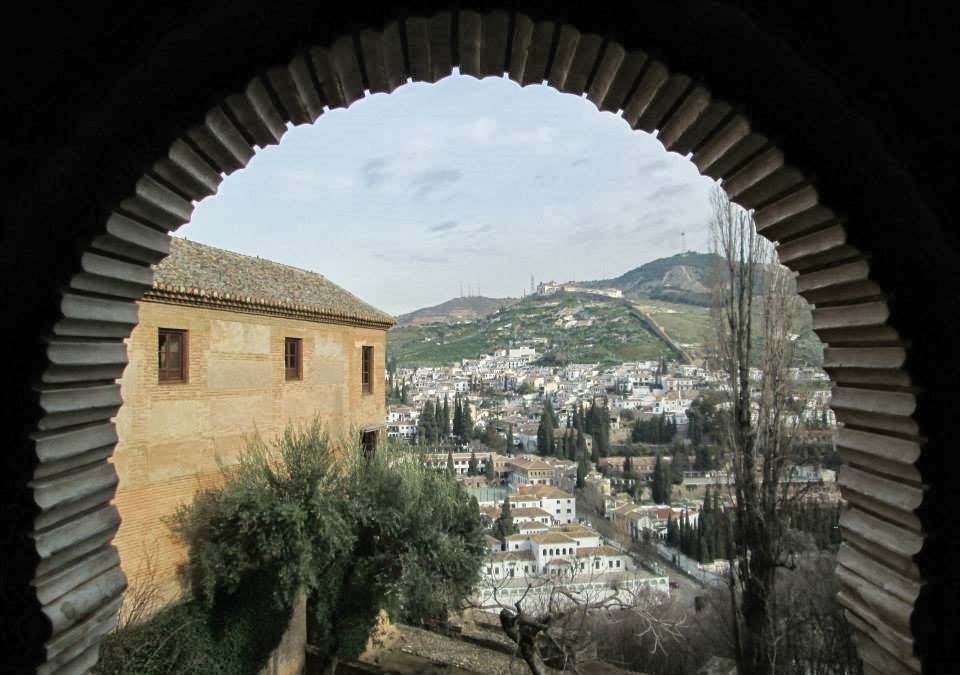
Solar Montes Clares is a small, Moroccan styled guesthouse. Everything is inch perfect and relaxed thanks to the endeavours of Antonio, who runs the place. Best of all are the views. The second I stepped out onto our balcony I knew all the kerfuffle of getting here was worth it. Slap bang in front of us was the Alhambra itself, lit up as night fell. Down below the cliffs which support it, the Albaicín sprawled up from the small river and over the hill to our right. Below the new city stretched out to the plain, via the spires of churches and, of course, the cathedral. Each night I sat out on our balcony reading to this view, accompanied by the complementary vino tinto.
We spent a couple of days dragging the double pram up and down the encaptivating streets of the Albaicín, peeping into grand churches that were once mosques, taking time out in small plazas and dropping down into town to find more great food. The small road which runs between the Albaicín and the river below the Alhambra was particularly vibrant. Granada is famous for its eclectic community and this route was lined with artists, artisans and musicians. Best of all was a large group playing gypsy inspired tunes which infused our eldest and a hundred other people with the jiggles. The place has a real buzz.
At the end of this road, the city flattens out into a series of wide open squares and a real mixture of building styles. 70’s monstrosities face off medieval churches. Find the right spot and there is little better than sitting back in a cosy square with beer, tapas and the passing warmth of February sunshine.
On our penultimate night we marched up to the sunset panorama in the Albaicín, a perfect place to whet the appetite for the trip up to the Alhambra the next morning. Situated at a high point before the land drops into the gulley at the bottom of the Alhambra hill, this vantage point provides an awesome view. The Sierra Nevada mountains dominate the backdrop. As they fall rapidly and give way to the flatlands and the city they thrust out one final arm of elevation. A high ridge jutting out into the populous, with steep cliffs on three sides. The palaces and castles of the Alhambra cling to the top of this ridge, peering down at those below. Quite a sight as the sun dives off the Western horizon in streams of red and orange.

THE ALHAMBRA
I have never met someone who has been to the Alhambra and not waxed lyrical about its magnificence and beauty. That is probably why you need to book your ticket way in advance. Fortunately we had had that insight. Early the next morning, we trekked up the back steps to the plateau at the top of the ridge with our small one in the Bjorn and our eldest on the shoulders.
When first hearing about the place I had imagined it would be relatively uniform in terms of style and date, like the Taj Mahal or Angkor Wat. From the very start of our visit it was evident that it is instead a hotchpotch of variety, made up of religious buildings, fortifications and, of course, palaces from a wide range of eras.
This makes sense when you think of the important natural position of strength that the ridge holds. Like the Acropolis in Athens, it has proved irresistable as a seat for power for millennia. You therefore have Visigothic archeological digs, next to Moorish baths, which are in turn just around the corner from the gordy renaissance palace of Charles V (Charles II from Spain’s perspective - the most powerful of sixteenth century Europeans).
The Moorish fort is large and stark, with high crenelated walls rising above the steep sides of the hill. At the further end of the hill from the mountains, the fortifications jut out into the city imposingly staring down at the minions. We had loads of fun climbing along the walls and staring out at the rarefied views from the parapets.
Peering into the Christian extension to the palace, we quickly moved on to what proved to be the undoubted pinnacle of our whole trip in Andalusia, the Nasrid Palaces. From the first antechamber, I was taken aback. Every surface was covered with carvings of exquisite intricacy and delicacy. Prohibited from recreating Allah’s creation in their work, the craftsman took the symmetrical, almost hypnotic form of Islamic art to a heightened level. Out of ideological constraints, human creativity reached new levels.
Passing through one courtyard after another, as no doubt intended by the creators, the splendour only increased, culminating at the Court of Lions, perhaps the most superlative piece of fine architecture I have witnessed. Designed and sculpted to mirror paradise, it comes strikingly close. A place that has to be seen to be believed. Go there!
Before leaving the Alhambra we had just enough time to wander up to the summer palace and gardens that adorn the hill above the main site. This is well worth a visit, providing fantastic views to the palace, city and plain beyond. To my mind at least, the stump of a centuries old cedar tree which once shaded the Muslim inhabitants of the Alhambra was a moving link to the past.

THE RECONQUSITA
It was fitting that our tour of Andalusia should end with a visit to the cavernous cathedral of Granada and, more specifically the Capilla Real which is adjoined to it. Here, tellingly, lie the Catholic Kings. In 1492 Granada fell and with it the 700 hundred year reign of the Moors in the Iberian peninsula. Ferdinand and Isabella had completed the crusade of the Reconquista, which forms the foundation stone of the Spanish nation to this day. In the fateful year of 1492, the world shifted. In the very same year as the fall of Granada, Columbus discovered the New World under the patronage of those very same royals, Ferdinand and Isabella. Staring at the tombs of husband and wife, you are in the decayed presence of prime movers. World changers.

With Christian conquest came a decline in science, art, architecture and tolerance. The Jews joined the Moors in forced exile. The inquisition followed. No longer would religions co-exist in relative peace and productivity. Soaking in the treasures and culture of Islamic Spain you can’t but feel that this was, at least in the medium term, a backward step. Thankfully, history leaves it mark, and the rich vein of influence left by people’s as diverse as Romans, Visigoths, Moors and Catholics has made this region into the simply fascinating place that it is today.

AN ALMOST COMIC DEPARTURE

It would be amiss to not share a short summary of our return to the UK and lacking context not to reiterate that we were travelling with our small boys who are but 20 months and 7 months respectively. As we were packing for departure, BA informed us by text that, due to an Iberia strike, our flight back to London from Malaga would be diverted to Gibraltar. Another country, but only a couple of hours away, no worries. Leaving Granada, the heavens had other ideas. After a couple of weeks of sunshine, a winter storm made its way in from the Atlantic and culminated in a non-stop torrential downpour. Pressing on we made it to the Spanish border with Gibraltar, dropped off the car and carried the family over the border (carry cots, car sears, suitcases, pram and, of course, kids). The rain was unrelenting and we were soaked as we passed through passport control with the weather battered Rock looming ahead.
We had made it. We ran into the terminal and went up to the desk. “I am sorry to inform you, but due to heavy winds, your plane cannot take off from Gibraltar”. Apparently Gibraltar has a very short runway and is hence prone to such things. The latest news was that we would be shipped onto buses and driven a few hundred KMs to Jerez, where they hoped to find a plane and break the Iberia strike. Better yet, we were required to still check in at Gibraltar, go through customs, wait, wait some more, then pick up all the luggage again and traipse back across the border by foot into Spain. The storm did us no favours and battered us some more. To their eternal credit, well past their bed time and wired, of the hundred or so passengers, our little ones were probably the most jovial when we made it on to the bus to Jerez.
A couple more hours later we made it to a small airport the other side of Andalusia and, greeted by many an anti-BA/Iberia strike sign but thankfully no strikers, made it through the doors and into departures. A long wait later we were onto a plane and on our way home. A real inconvenience in normal conditions. A real adventure with two babies. We made it home via three plane diversions with only three nappies. The joys of family travel!

Saturday, September 07, 2013

Al Andalus - Cordoba

Driving north across the plain from Seville, two bright lights parried my vision. The first, unremarkably for this non-dreary part of the world, was the sun. The second I could not quite figure out. Blindingly bright and drawing ever nearer from the horizon, it did not lag far behind the sun in its intensity. As we drew closer, it became apparent that this was not a single light, but a myriad of separated groups of solar beams firing in an ordered pattern between the earth and a single point in the sky. A bit like a monolithic disco ball.  Drawing closer still, I could see the large concrete tower which housed this giant reflecting (or receiving) object. My best guess is that this forms part of an ambitious solar energy complex.  Remarkable and quite unlike anything I have seen before.

Apart from the disco ball, the road to Cordoba was largely forgettable. Cordoba itself was anything but.

LA CIUDAD ANTIGUA 

We were staying on the other side of the Guadalaquivir river from the old city. Leaning out of our window, I was astounded by the view. A partially reconstructed Roman bridge spans a wide fast flowing stretch of water, broken up by copse-laden and ruin-strewn islets. On the far side, the bridge lands beneath the imposing city walls, with the Mezquita, the jewel in Cordoba’s crown, dominating the view above. More of that later.
Around the Mezquita are a warren of wonderfully preserved medieval streets. My uncle, whose opinions I respect above most on such matters, thinks it is the best preserved medieval city in Europe, and I certainly had no reason to argue. Once past the tourist tat of the immediate vicinity we lost ourselves in the winding alleys of whitewashed stone work, occasionally sneaking a peak at the inner courtyards of 500 year old mansions. It is an endearing feature of pre and post-colonial Spanish architecture that the true grandeur of buildings is enticingly hidden from view.  Inner gardens and terraces which resemble, and presumably originate from, the Moorish style.
Once out of the old town, the picturesque nature of the city quickly diminishes, but it is still full of surprises. Meandering through busy shopping streets, an ugly road interchange is interrupted by a Roman temple. Just up the street, an unattractive square is brought to life by a bunch of chicos playing Spanish guitar and singing. Nothing special you might think, but these guys weren’t part of an act or busking. They were just sitting in a café, chilling out, smoking fags and making music for their own enjoyment. The little ones absolutely loved it.

My favourite place in Cordoba was Plaza de la Corredera. A large seventeenth century square hemmed in by four-storey town houses. A little run down, it was populated by a rag tag of friendly restaurants selling tapas and beer at a song, students playing guitar and old men watching the world pass by. A little out of the way and seriously charming. We came back each day of our stay, chowing down on chorizo in vino tinto and patatas bravas (our eldest’s favourite word in Andalusia quickly became “patata-patata”)

THE MEZQUITA

A unique treasure and one of the most impressive structures in Europe, it is hard not to spit superlatives about this place. Like many of the cities in these parts, Cordoba has Roman roots and a Visigothic past, but the Moors made the place, with Islam at its core.
Cordoba was the capital of a powerful caliphate. At its height, it was the most sophisticated and cultured centre in Western Europe. The Mezquita was its pinnacle. From our perspective, a gift to the future. From the perspective of the Moors, the centre of Islam and life in Al Andalus. A place to submit to the God who delivered to them and their kin lands stretching from the Atlantic to the Gulf.

Originally started in the eighth century on the spot of a Visigothic church and expanded over subsequent generations, the mosque followed the normal pattern of minaret, ablution garden and prayer hall. Beyond that it is anything but the norm. A supreme combination of scale, minutiae and, most of all, balance. One of the largest buildings erected in Europe between the fall of Rome and the Renaissance, yet decorated with such painstaking intricacy. This attention to detail is especially apparent in the oldest parts. Indeed, it is said you can see the slow decline of the Caliphate in the mild degeneration of particulars as each new section was built.

What is most striking about the Mezquita is its internal symmetry and harmony.  Entering from the garden of ablutions through grand carved doors, you step into the vast prayer hall and encounter row after row after row after row of parallel, adjoining Islamic arches, each decorated in a simple red and white pattern. It has a different impact to the vast cavernous space of a cathedral. More intimate, yet no less impressive or imposing. It affected me like very few buildings have. A place of heightened calm. I felt momentarily lost drifting around the fringes of this huge rectangle space.

After the Reconquista seized back Cordoba, we have the Catholics to thank for not tearing down this masterpiece of human ingenuity and endeavour. They took the building in the name of their own god. On the flip side, the Catholics almost unforgivably tore a huge hole in the heart of the Mesquite and threw up a gaudy cathedral. In another context it would no doubt be an impressive building, but entering from the serenity of the surrounding Islamic arches it just resembles expensive tack. A bit like throwing up a Disney World at the heart of Tuscany. 
This violation was not lost on contemporaries. Charles V famously remarked "they have taken something unique in all the world and destroyed it to build something you can find in any city". One can only try and imagine how more magnificent this structure must have been before the Christian monstrosity.


A FINAL VIEW

After a walk around the beautiful gardens of the old fort, we made our way back to the river as the sun was setting. Stepping onto the bridge we took a moment to stop and stare. Narrowing shards of sunlight disintegrated into the thin mist which hung to the rapid current. To our right the remains of a Roman watermill. To our left, crumbling fortifications. Left, right and centre, hundreds of cormorants circling, swimming, dipping into the flow or, wings flung wide, basking in the glory of the end of the day. Far ahead loomed the fortified hills which showed the way to Granada.