Wednesday, October 23, 2013

Al Andalus - Granada

Central Andalusia is a relatively barren, hilly country. Once Cordoba fell to the Catholics, this was the frontier zone between Christianity and the last stronghold of Islam in Western Europe, Granada. As a product of those times, towns and villages were largely built on hill tops and fortified against the opposing side. This has left a beautiful spectacle for those driving through, as the roads skirt below white-washed towns with the obligatory crumbling fort.
I have wanted to visit Granada for a very long time and my first glimpse galvanised my growing excitement. Coming to the end of a high pass, the hills split and dropped, exposing a wide valley stretching to the snow-capped Sierra Nevada. Just visible, nestled in the rising roots of the mountain range, Granada sat invitingly.
Being a bit of a romantic, I had booked to stay in a guesthouse high above the city centre at the meeting point of the historic Albaicín district and Sacromonte, home to centuries old picturesque gypsy cave settlements. This area has no parking and I will spare you the details of shifting two kids under 20 months old with all their cots and baby paraphernalia from an out of town multi storey car park, across the whole city, through the narrow streets of the old town, part the way up a mountain and up to a villa that can only be reached via a crumbling winding stair. Impractical, but worth it, the place was amazing.
Solar Montes Clares is a small, Moroccan styled guesthouse. Everything is inch perfect and relaxed thanks to the endeavours of Antonio, who runs the place. Best of all are the views. The second I stepped out onto our balcony I knew all the kerfuffle of getting here was worth it. Slap bang in front of us was the Alhambra itself, lit up as night fell. Down below the cliffs which support it, the Albaicín sprawled up from the small river and over the hill to our right. Below the new city stretched out to the plain, via the spires of churches and, of course, the cathedral. Each night I sat out on our balcony reading to this view, accompanied by the complementary vino tinto.
We spent a couple of days dragging the double pram up and down the encaptivating streets of the Albaicín, peeping into grand churches that were once mosques, taking time out in small plazas and dropping down into town to find more great food. The small road which runs between the Albaicín and the river below the Alhambra was particularly vibrant. Granada is famous for its eclectic community and this route was lined with artists, artisans and musicians. Best of all was a large group playing gypsy inspired tunes which infused our eldest and a hundred other people with the jiggles. The place has a real buzz.
At the end of this road, the city flattens out into a series of wide open squares and a real mixture of building styles. 70’s monstrosities face off medieval churches. Find the right spot and there is little better than sitting back in a cosy square with beer, tapas and the passing warmth of February sunshine.
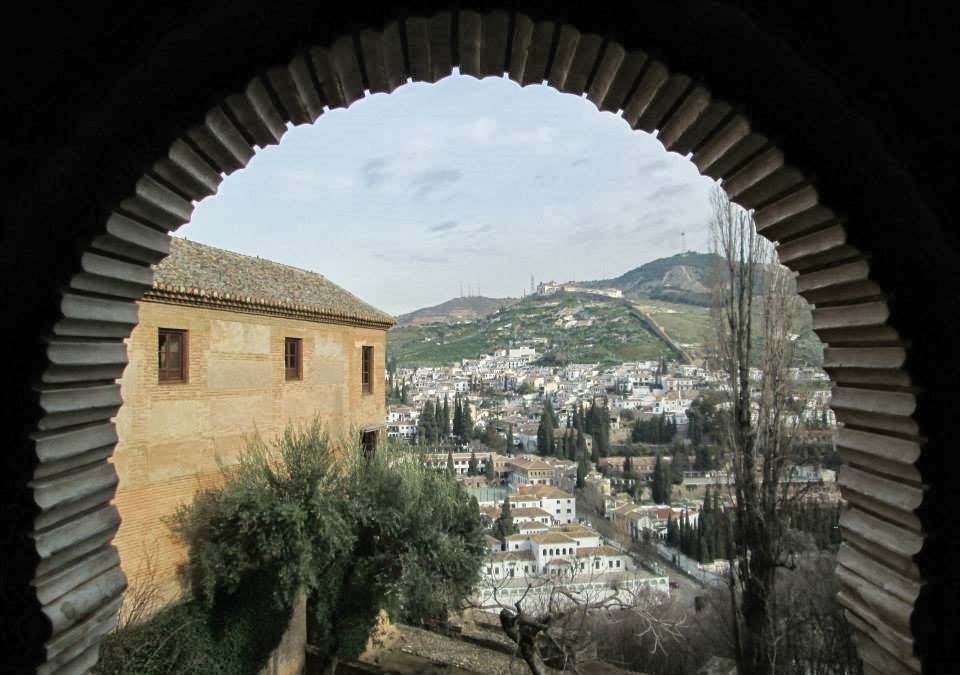
On our penultimate night we marched up to the sunset panorama in the Albaicín, a perfect place to whet the appetite for the trip up to the Alhambra the next morning. Situated at a high point before the land drops into the gulley at the bottom of the Alhambra hill, this vantage point provides an awesome view. The Sierra Nevada mountains dominate the backdrop. As they fall rapidly and give way to the flatlands and the city they thrust out one final arm of elevation. A high ridge jutting out into the populous, with steep cliffs on three sides. The palaces and castles of the Alhambra cling to the top of this ridge, peering down at those below. Quite a sight as the sun dives off the Western horizon in streams of red and orange.

THE ALHAMBRA
I have never met someone who has been to the Alhambra and not waxed lyrical about its magnificence and beauty. That is probably why you need to book your ticket way in advance. Fortunately we had had that insight. Early the next morning, we trekked up the back steps to the plateau at the top of the ridge with our small one in the Bjorn and our eldest on the shoulders.
When first hearing about the place I had imagined it would be relatively uniform in terms of style and date, like the Taj Mahal or Angkor Wat. From the very start of our visit it was evident that it is instead a hotchpotch of variety, made up of religious buildings, fortifications and, of course, palaces from a wide range of eras.
This makes sense when you think of the important natural position of strength that the ridge holds. Like the Acropolis in Athens, it has proved irresistable as a seat for power for millennia. You therefore have Visigothic archeological digs, next to Moorish baths, which are in turn just around the corner from the gordy renaissance palace of Charles V (Charles II from Spain’s perspective - the most powerful of sixteenth century Europeans).
The Moorish fort is large and stark, with high crenelated walls rising above the steep sides of the hill. At the further end of the hill from the mountains, the fortifications jut out into the city imposingly staring down at the minions. We had loads of fun climbing along the walls and staring out at the rarefied views from the parapets.
Peering into the Christian extension to the palace, we quickly moved on to what proved to be the undoubted pinnacle of our whole trip in Andalusia, the Nasrid Palaces. From the first antechamber, I was taken aback. Every surface was covered with carvings of exquisite intricacy and delicacy. Prohibited from recreating Allah’s creation in their work, the craftsman took the symmetrical, almost hypnotic form of Islamic art to a heightened level. Out of ideological constraints, human creativity reached new levels.
Passing through one courtyard after another, as no doubt intended by the creators, the splendour only increased, culminating at the Court of Lions, perhaps the most superlative piece of fine architecture I have witnessed. Designed and sculpted to mirror paradise, it comes strikingly close. A place that has to be seen to be believed. Go there!
Before leaving the Alhambra we had just enough time to wander up to the summer palace and gardens that adorn the hill above the main site. This is well worth a visit, providing fantastic views to the palace, city and plain beyond. To my mind at least, the stump of a centuries old cedar tree which once shaded the Muslim inhabitants of the Alhambra was a moving link to the past.

THE RECONQUSITA
It was fitting that our tour of Andalusia should end with a visit to the cavernous cathedral of Granada and, more specifically the Capilla Real which is adjoined to it. Here, tellingly, lie the Catholic Kings. In 1492 Granada fell and with it the 700 hundred year reign of the Moors in the Iberian peninsula. Ferdinand and Isabella had completed the crusade of the Reconquista, which forms the foundation stone of the Spanish nation to this day. In the fateful year of 1492, the world shifted. In the very same year as the fall of Granada, Columbus discovered the New World under the patronage of those very same royals, Ferdinand and Isabella. Staring at the tombs of husband and wife, you are in the decayed presence of prime movers. World changers.

With Christian conquest came a decline in science, art, architecture and tolerance. The Jews joined the Moors in forced exile. The inquisition followed. No longer would religions co-exist in relative peace and productivity. Soaking in the treasures and culture of Islamic Spain you can’t but feel that this was, at least in the medium term, a backward step. Thankfully, history leaves it mark, and the rich vein of influence left by people’s as diverse as Romans, Visigoths, Moors and Catholics has made this region into the simply fascinating place that it is today.

AN ALMOST COMIC DEPARTURE

It would be amiss to not share a short summary of our return to the UK and lacking context not to reiterate that we were travelling with our small boys who are but 20 months and 7 months respectively. As we were packing for departure, BA informed us by text that, due to an Iberia strike, our flight back to London from Malaga would be diverted to Gibraltar. Another country, but only a couple of hours away, no worries. Leaving Granada, the heavens had other ideas. After a couple of weeks of sunshine, a winter storm made its way in from the Atlantic and culminated in a non-stop torrential downpour. Pressing on we made it to the Spanish border with Gibraltar, dropped off the car and carried the family over the border (carry cots, car sears, suitcases, pram and, of course, kids). The rain was unrelenting and we were soaked as we passed through passport control with the weather battered Rock looming ahead.
We had made it. We ran into the terminal and went up to the desk. “I am sorry to inform you, but due to heavy winds, your plane cannot take off from Gibraltar”. Apparently Gibraltar has a very short runway and is hence prone to such things. The latest news was that we would be shipped onto buses and driven a few hundred KMs to Jerez, where they hoped to find a plane and break the Iberia strike. Better yet, we were required to still check in at Gibraltar, go through customs, wait, wait some more, then pick up all the luggage again and traipse back across the border by foot into Spain. The storm did us no favours and battered us some more. To their eternal credit, well past their bed time and wired, of the hundred or so passengers, our little ones were probably the most jovial when we made it on to the bus to Jerez.
A couple more hours later we made it to a small airport the other side of Andalusia and, greeted by many an anti-BA/Iberia strike sign but thankfully no strikers, made it through the doors and into departures. A long wait later we were onto a plane and on our way home. A real inconvenience in normal conditions. A real adventure with two babies. We made it home via three plane diversions with only three nappies. The joys of family travel!

Saturday, September 07, 2013

Al Andalus - Cordoba

Driving north across the plain from Seville, two bright lights parried my vision. The first, unremarkably for this non-dreary part of the world, was the sun. The second I could not quite figure out. Blindingly bright and drawing ever nearer from the horizon, it did not lag far behind the sun in its intensity. As we drew closer, it became apparent that this was not a single light, but a myriad of separated groups of solar beams firing in an ordered pattern between the earth and a single point in the sky. A bit like a monolithic disco ball.  Drawing closer still, I could see the large concrete tower which housed this giant reflecting (or receiving) object. My best guess is that this forms part of an ambitious solar energy complex.  Remarkable and quite unlike anything I have seen before.

Apart from the disco ball, the road to Cordoba was largely forgettable. Cordoba itself was anything but.

LA CIUDAD ANTIGUA 

We were staying on the other side of the Guadalaquivir river from the old city. Leaning out of our window, I was astounded by the view. A partially reconstructed Roman bridge spans a wide fast flowing stretch of water, broken up by copse-laden and ruin-strewn islets. On the far side, the bridge lands beneath the imposing city walls, with the Mezquita, the jewel in Cordoba’s crown, dominating the view above. More of that later.
Around the Mezquita are a warren of wonderfully preserved medieval streets. My uncle, whose opinions I respect above most on such matters, thinks it is the best preserved medieval city in Europe, and I certainly had no reason to argue. Once past the tourist tat of the immediate vicinity we lost ourselves in the winding alleys of whitewashed stone work, occasionally sneaking a peak at the inner courtyards of 500 year old mansions. It is an endearing feature of pre and post-colonial Spanish architecture that the true grandeur of buildings is enticingly hidden from view.  Inner gardens and terraces which resemble, and presumably originate from, the Moorish style.
Once out of the old town, the picturesque nature of the city quickly diminishes, but it is still full of surprises. Meandering through busy shopping streets, an ugly road interchange is interrupted by a Roman temple. Just up the street, an unattractive square is brought to life by a bunch of chicos playing Spanish guitar and singing. Nothing special you might think, but these guys weren’t part of an act or busking. They were just sitting in a café, chilling out, smoking fags and making music for their own enjoyment. The little ones absolutely loved it.

My favourite place in Cordoba was Plaza de la Corredera. A large seventeenth century square hemmed in by four-storey town houses. A little run down, it was populated by a rag tag of friendly restaurants selling tapas and beer at a song, students playing guitar and old men watching the world pass by. A little out of the way and seriously charming. We came back each day of our stay, chowing down on chorizo in vino tinto and patatas bravas (our eldest’s favourite word in Andalusia quickly became “patata-patata”)

THE MEZQUITA

A unique treasure and one of the most impressive structures in Europe, it is hard not to spit superlatives about this place. Like many of the cities in these parts, Cordoba has Roman roots and a Visigothic past, but the Moors made the place, with Islam at its core.
Cordoba was the capital of a powerful caliphate. At its height, it was the most sophisticated and cultured centre in Western Europe. The Mezquita was its pinnacle. From our perspective, a gift to the future. From the perspective of the Moors, the centre of Islam and life in Al Andalus. A place to submit to the God who delivered to them and their kin lands stretching from the Atlantic to the Gulf.

Originally started in the eighth century on the spot of a Visigothic church and expanded over subsequent generations, the mosque followed the normal pattern of minaret, ablution garden and prayer hall. Beyond that it is anything but the norm. A supreme combination of scale, minutiae and, most of all, balance. One of the largest buildings erected in Europe between the fall of Rome and the Renaissance, yet decorated with such painstaking intricacy. This attention to detail is especially apparent in the oldest parts. Indeed, it is said you can see the slow decline of the Caliphate in the mild degeneration of particulars as each new section was built.

What is most striking about the Mezquita is its internal symmetry and harmony.  Entering from the garden of ablutions through grand carved doors, you step into the vast prayer hall and encounter row after row after row after row of parallel, adjoining Islamic arches, each decorated in a simple red and white pattern. It has a different impact to the vast cavernous space of a cathedral. More intimate, yet no less impressive or imposing. It affected me like very few buildings have. A place of heightened calm. I felt momentarily lost drifting around the fringes of this huge rectangle space.

After the Reconquista seized back Cordoba, we have the Catholics to thank for not tearing down this masterpiece of human ingenuity and endeavour. They took the building in the name of their own god. On the flip side, the Catholics almost unforgivably tore a huge hole in the heart of the Mesquite and threw up a gaudy cathedral. In another context it would no doubt be an impressive building, but entering from the serenity of the surrounding Islamic arches it just resembles expensive tack. A bit like throwing up a Disney World at the heart of Tuscany. 
This violation was not lost on contemporaries. Charles V famously remarked "they have taken something unique in all the world and destroyed it to build something you can find in any city". One can only try and imagine how more magnificent this structure must have been before the Christian monstrosity.


A FINAL VIEW

After a walk around the beautiful gardens of the old fort, we made our way back to the river as the sun was setting. Stepping onto the bridge we took a moment to stop and stare. Narrowing shards of sunlight disintegrated into the thin mist which hung to the rapid current. To our right the remains of a Roman watermill. To our left, crumbling fortifications. Left, right and centre, hundreds of cormorants circling, swimming, dipping into the flow or, wings flung wide, basking in the glory of the end of the day. Far ahead loomed the fortified hills which showed the way to Granada.

Saturday, August 03, 2013

Al Andalus - Seville


We spend four days in Seville and it was not nearly sufficient. A grand city, it has the feel of a great European capital while still retaining the laid-back nature of the region. A chilled out Paris with friendly people.

Straddling the banks of the Guadaquivir not far from the remains of Roman Italica, Seville has had its fair share of glory days. The old town is a conglomeration of pretty streets and squares punctuated by stand-out buildings leftover from headier times. At its heart is the Cathedral de Santa Maria de la Sede.
Build, upon, around and inside the old grand mosque, the building symbolises the triumph of the Reconquista, is vast and very impressive. Indeed it is the largest Gothic cathedral in the world. On entering, Niko looked up at the ceiling way above and span round and round lost in its vastness (or at least that was my interpretation…). I did the same thing and so must have people for centuries. The religion fuelled ambition is remarkable. To build such a building today would be a very expensive headache, but the mind boggles at the difficulty of building it back then.  My favourite features are though Islamic.

Neighbouring the main structure of the church is the orange garden which started its life as the garden of ablution for the original mosque. A place of peace and calm, still with the original water channels to feed the trees. Above the Giralda, the remnants of the mosque's minaret, rises up to the heavens. Shortened and converted into a bell tower, it still stands 105 m tall. When originally built in the twelfth century it was the tallest structure in the world. An astounding place, showing the fusion of cultures which makes the region so special.
Crossing a horse and cart strewn square from the Cathedral the bold gates of the Alcazar hold the view. Walk through and you enter the fortress and palace of the Muslim emirs and then Catholic kings. While the intricacy and scale of the palace is impressive, it is the gardens that take the biscuit. Enclosed by the fortified walls, they are varied, lush and carefully laid out to calm the mind and put one at peace.
Seville encapsulates the laid back grand nature of a Spanish imperial city. Spiralling around the old town from these core, it was like I was back in Quito or La Candelaria in Bogota. In fact one corner was so similar to Cuzco that I had a flashback to an unfortunate Peruvian encounter with a group of thugs intent on robbing and beating me (fortunately the combination of warnings from a kind little old lady, a big stick and fast turn of heels just about got me out of that one!).
Not for a long time will I forget walking along the broad walkways which line the Guadaquivir river as the sun set.  A circular Moorish fort still stands guard, its stone work shown off by the narrowing spectrum of light.

Behind this is the opulent Parque de Maria Luisa, stretching on through one variety of horticulture to another and, at its centre, the preposterous Plaza de Espana. A little downstream is the huge Plaza de Toros, one of the oldest bullrings in Spain and only second in stature to the bullring in Madrid. A tour illustrated just how refined and steeped in history this much derided blood sport is. Along with the inherent savagery comes tradition, skill and bravery. I left with a desire to witness it in the flesh (so to speak). Next time.

So many remnants of rich and, depending upon your perspective, glorious times. It gets me to thinking of what our times will leave behind. We are richer than any other time in history (in an absolute if not always a relative sense), but what grand public structures and parks will we leave behind to startle and confound those centuries henceforth? I suspect a disappointing number. Canary Wharf definitely does not count.

ONWARDS AND OUT

Seville really is a wonderful city. Alongside its clear aesthetic attributes, most of all I was captured by the charm off its people. From the friendly waiter who late on our first night warmly welcomed into his restaurant two tired parents with two even more tired tiny children, to ice-cream sellers who wanted our life story. Great, engaging people.
I was sad to move on, but move on we did via some very confused driving through the confounding one way system of the old town and an emergency U-turn on a main thoroughfare. Bring on Cordoba!

Friday, June 28, 2013

Al Andalus – Ronda


Quickly brushing past the ugly over-development of the Cost del Sol we climbed up and over the coastal hills to the spectacular town of Ronda. Having put some significant elevation between us and the coast, the warmth of the Med was lost to a bitterly cold chill. Nonetheless we locked down the little ones in the pram and went to explore.  
 
Ronda is famous for having the oldest bullring in Spain. Dating from 1784, it is small but perfectly formed. A whitewashed round, topped by terracotta.  Fittingly, we feasted on oxtail at the neighbouring Pedro Romero, in the company of mounted bull heads and memorabilia of famous fights and fighters.
Ronda has its fair share of picturesque medieval cobbled streets, mansions and churches, but what makes it stand out is its simply ridiculous setting. The town steadily rises from the high plain before unexpectedly giving way to sheer cliffs. Beyond, the rugged, striking countryside stretches out for miles to wide ridges which hem in the wider high valley.  A feast for the eyes and, in our case, the senses, as we were buffeted by winds so strong that all but a trace of my exhilarated shrieks were drowned out of existence.  
 
To cap it all off, the town is sundered in two by a deep canyon which cracks open the cliffs and strafes its way back and forth into the land behind. This geological rift is crossed by an oft-photographed medieval bridge which, as Christina will verify, is exceptional in its vertigo prompting qualities as well as its ingenuity.

Sad to leave, we jumped back in the wagon and headed North-West. Past the edge of the valley the winding mountain roads slowly straightened, leading on to an odd hilly terrain with undulations which resembled a rolling ocean. A bit further and the land ironed out into the plains of Seville, our next destination.